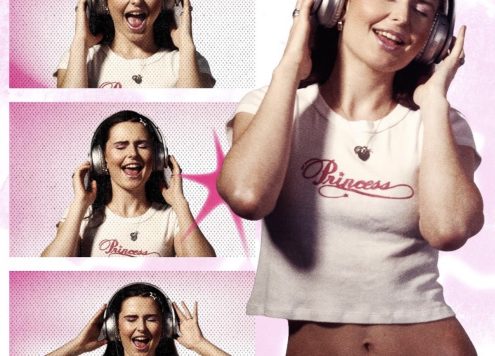
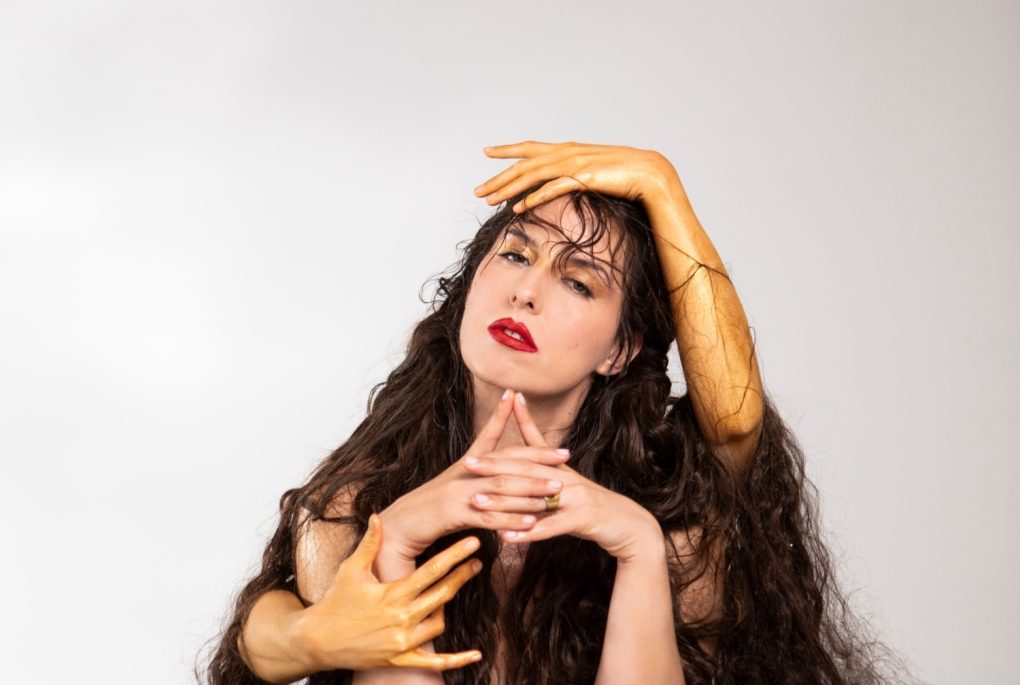
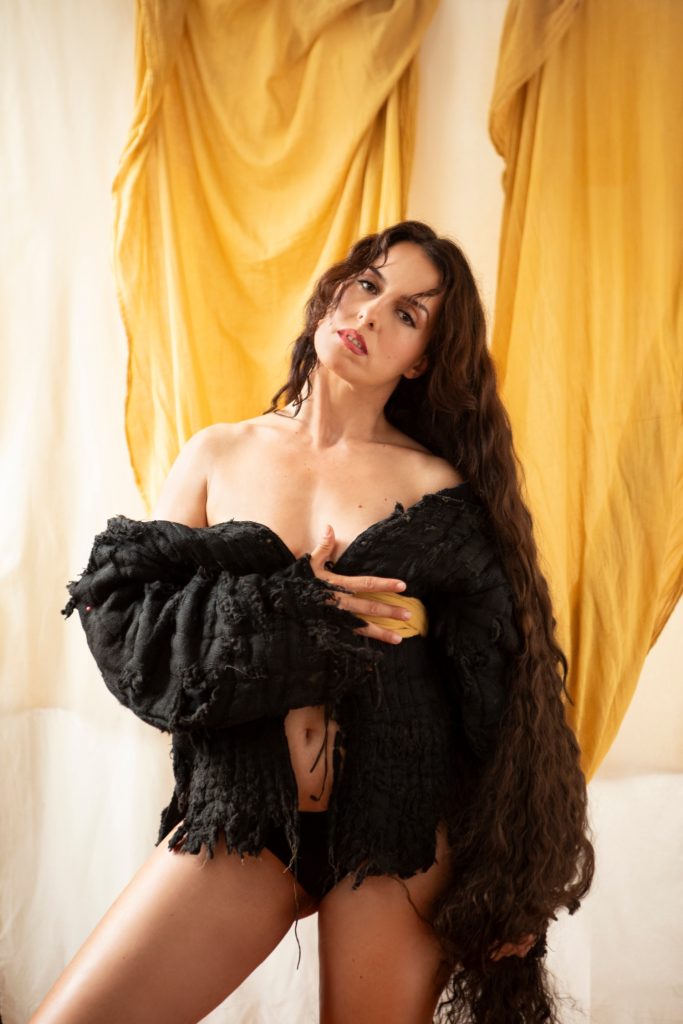
Spanish-Italian singer, songwriter, and multi-instrumentalist Angela Merlino continues to carve her own path in the emerging realm of Tribal Pop, weaving her multicultural roots into a sound defined by healing, depth, and boundary-breaking artistry. Following a stream of acclaimed performances across Europe and her evolution as a producer and sound designer, she now steps forward with ‘Water Mantra’, the hypnotic title track from her forthcoming EP; a piece that fuses Folk Tribal percussion with Alternative Pop while showcasing her trilingual vocal approach in English, Spanish, and Sanskrit. Having grown from intimate roots in Galicia and Manresa to a flourishing creative life in London, her music channels ancestral tradition, spiritual exploration, and modern experimentation, marking her as one of the most compelling new voices in global fusion music.
With the release of ‘Water Mantra’ and its profound message of resilience; alongside a campaign supporting The Survivors Trust, Angela Merlino sets the stage for a powerful new chapter.
What first sparked your curiosity for blending your Spanish and Italian roots with Tribal percussion and Sound Healing elements?
I grew up listening to my grandad who was from Cordova, Spain, singing flamenco “Canto Hondo”, also hearing him play percussion on tables, doors and pretty much anything that could make a sound. We used to play claps and sing together since I was a child.
Then, on the other side, I had my dad at home, who was from Pulglia, Italy. I grew up seeing my dad play electric guitar in a band and composing and recording his own songs, and you know. Music was always in my household. My dad brought me into listening to all sorts of Italian Classics since I can remember.
Tribal percussion is something that I was drawn to since I was a child, Flamenco can be very percussive and very tribal too. So I guess that’s where all the Tribal influence comes from for me. Also I grew up in Manresa, Barcelona, where we have one of the biggest festivals of Catalonia called “The Fire Run” or also called “El Correfoc” in our language Catalan. Those festivals are purely Tribal Percussion, I do recommend anyone to experience those festivals. Most of my Tribal Sounds come from there too!
But since I was a child I always felt deeply attracted and connected to Indigenous cultures. There is something really deep about tribal drums, it is something that my mind can’t comprehend but only my body and soul can perceive, and the Tribal drum sound just makes me move inside out. There is also a healing aspect in drums, since drummings has been connected to ceremonies since the beginning of human existence. So Tribal drums is not only the beginning, it is also the present and the future for Music.
I feel the pleasure and the duty of keeping our ancestral cultures alive, and also respect our indigenous tribes on the planet, and they are very important for our ecosystem, they are our biggest teachers.
The healing aspect of my music might have something to do with me being spiritual and I like to chant, meditate every day and learn Mantras in Sanskrit. Maybe because I am married to someone from India and I did spend a long time in India too. I believe that healing is the solution for our planet and our people, if we all can access to healing the world would be less mean and more loving. So I guess that’s the whole goal. I believe everyone is good from the start but some people might suffer traumas and that makes them behave in a certain ways, so that’s why I use healing ancestral sounds in my music.
How has living in London influenced the way you approach composing and designing your sonic landscapes today?
My songs are just a recall of my deepest thoughts and emotions, plus every sound I heard at the time I was going through that specific situation.
I just like to take sounds from the environment where I live in, I find it much more exciting and interesting. I want my music to be unique, so I prefer to build my sound base from scratch. My music tends to be muddy in general because of that, I guess just like London’s soundscape is muddy, you can hear cars, the sound of ambulances all the time and the constant movement of energy, which can be kind of dark sometimes too, if you know what I mean?
You sing in three languages—how do you decide which one a particular song calls for, emotionally or sonically?
I guess it depends on what I want to express. If I want to create a healing sound pattern then I would probably throw a bit of Sanskrit in it, because Sanskrit Mantras can heal our bodies, that’s what they are for. If I want to express something that happened to me whilst I was living in Spain, then it will probably come naturally to me to sing it or express it in Spanish, as it is my mother tongue language.
But for example, if the experience was connected to Italy, then I would probably express myself better in Italian (which is my father tongue’s language).
But overall I always dreamed of singing in English, even when I did not know even a word of it! I find English is such a beautiful language to sing in, and it feels really natural to me after being in the UK for over 14 years of my life.
When you began shaping ‘Water Mantra’, what was the earliest creative seed that told you, “This is the direction this track needs to go”?
The sound of water in the shower. The water drops gave me the bpm of the song, and that gave me the percussion pattern. I usually create from percussion not from melody.
The percussion in ‘Water Mantra’ feels ancient yet contemporary—how did you build that rhythmic world from the ground up?
In Spain, we have something called “Las Batucadas”, which are organised groups of people who play only drums for each and everyone of our festivals. For example, you must have heard about our “Semana Santa” at Easter. The way we do it in Spain is pretty much millions of people playing percussion instruments throughout the whole city for several hours and days, in these kind of festivals you might also hear trumpets, which are also included in my song Water Mantra, this is where my influence comes from, it comes from our most ancient Hispanic traditions, which of course, these are not all purely from Spain, but also carry a big influence from various South American Indigenous cultures, if we go back in time.
I personally got inspired by 2 Spanish Festivals: the “Fire Run Festival” that we celebrate in my city in Manresa, Catalonia every year. Our Festivals are purely Tribal Percussion and Dance, and “Semana Santa” at Easter in South Spain, because my grandparents come from Seville and Cordova and this is also part of my roots.
As I said earlier, my partner is from India, and I learned a lot of percussion in India too, such as tabla. Indian Music has a huge Tribal inclination and its’ full of healing instruments, starting from Traditional Indian Music to more commercial sorts of music. And also I have been to too many Bollywood parties! So that really got stuck in my head! Lol.
You’ve mentioned channeling the environments you explore into your music—can you walk us through a moment when a place directly shifted the sound or structure of this EP?
I created ‘Water Mantra‘ whilst I was in the shower, so the first sound I got was the water drops that were falling from the shower into the bathtub, so I recorded those with my Zoom Recorder. The water drops gave me the bpm of the song already, so with that I started singing a Mantra in Spanish, and I just started layering sounds over other sounds that I found or remembered from the environment I was into at the time.
‘Water Mantra‘ is a song that I wrote to express my pain of being sexually abused as a child at the age of 8. So I used car crash sounds in water Mantra, because those are the sounds and noises I heard when I was going through what I was going through at the age of 8. I recalled all the sounds that I heard and I deduce to display them in the track to re-create the story.
The car crash sound was the sound of the abuser driving me somewhere. A pretty scary situation to be honest. And like that all the elements I used are connected to an experience.
As ‘Water Mantra’ confronts deep personal pain, how did you balance staying truthful to your story while still protecting your emotional wellbeing during the creative process?
The way I see it is that pain is like a tap, if you open the tap little by little every day… The first water that will run through that tap will be dirty, and the more you keep opening the tap the more the pipe keeps unwigning, and the more clean water will run through the tap, until it will be completely clean water.
But if you don’t run the tap, how are you going to let the water out? Means… I believe the only way to heal is through expression. And music is a gift and a tool that we can use to heal ourselves.
I know it can be difficult for people to talk about this kind of situations but trying to keep your S*it together will not benefit the creative or healing process, you need to be ready to really express your deepest truth in the most raw possible way. This is what Somatic therapy and Healing taught me. So I learned how to stop trying to control my emotion output and find my truth in every word and in every step. So by the time I was involved in the creative process I was not scared to lose anything, because I already trusted my own truth, even if it was dark as hell.
Donating 60% of the EP’s proceeds to The Survivors Trust is powerful—what do you hope listeners and fellow survivors feel when they engage with this body of work?
I don’t expect or hope for anything. I just felt the Survivors Trust was the Charity I resonated the most with, because of the way they approached and helped Survivors. I am not trying to achieve anything, it is more like a call to do what feels right to me. And I think people need healing, so I decided to donate the 60% of the EP’s benefits to the Survivors Trust because it just felt the right thing to do. No expectations. My only job here is to express myself and be true to myself, the rest is in the universe or God’s hands, not mine.
You’ve said Tribal Pop will be “a thing in the future”—what does that future look like to you, and where do you see your role within it?
Of course, I am sure I must not be the only one in the world making Tribal Pop today, but I do believe that Tribal Pop is the future Music genre and I see myself as one of the main pioneers of Tribal Pop in the music scene.
if Angela Merlino hosted her own global Tribal Pop festival, what would you name it and what vibe would you want people to walk away with?
Freedom
Stream ‘Water Mantra’:
Follow Angela Merlino:
Spotify – Facebook – Instagram – Youtube – TikTok